
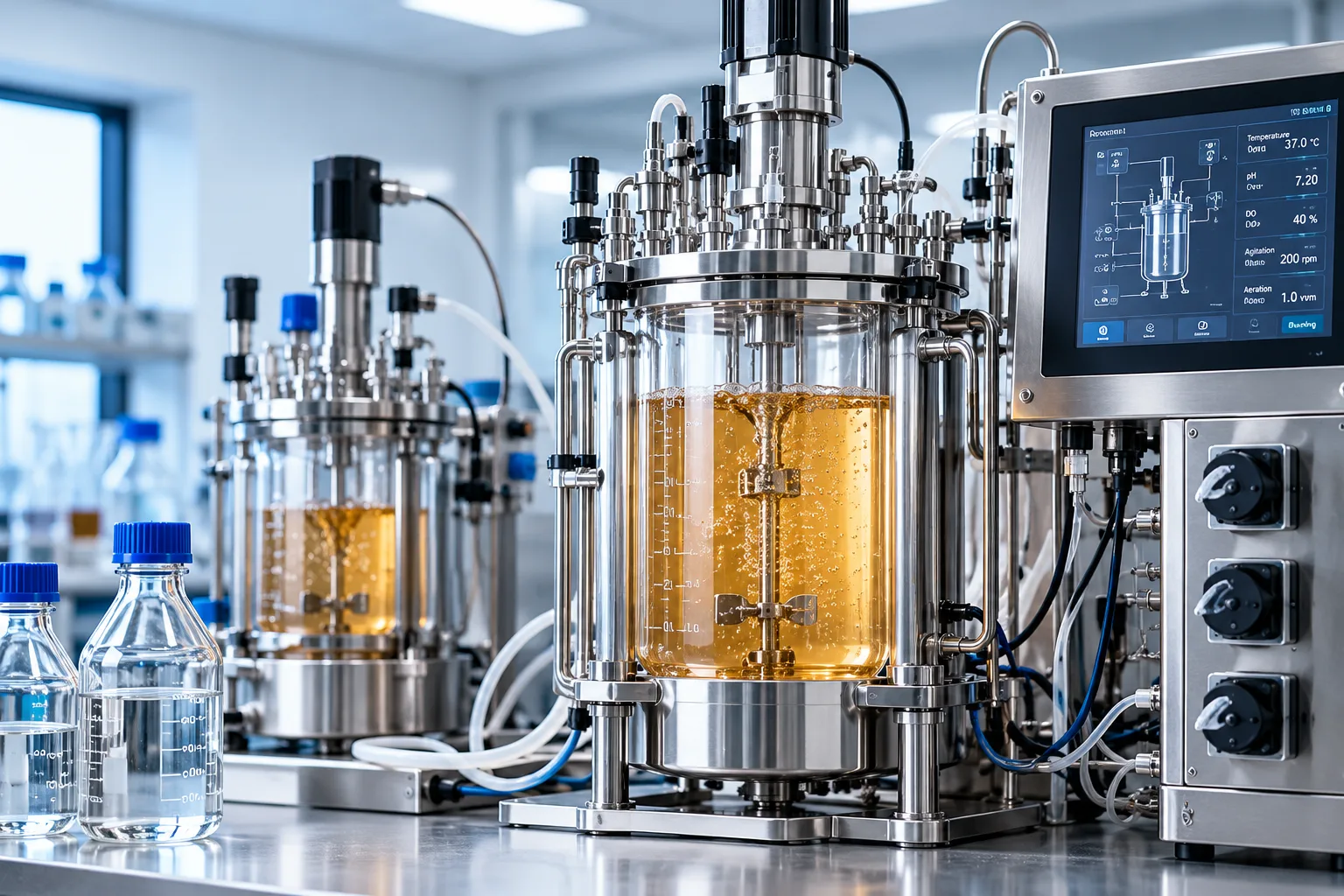
Bioprocessing Research: Lab-Scale Fermentation and Process Development
Bioprocessing research asks how to grow cells efficiently and make them produce more of what you want. At laboratory scale that means testing strains, media, temperatures, pH set points, aeration and feeding strategies, then carrying the best conditions forward to pilot scale.
The quality of that work depends on control. A bioreactor holds and records the conditions that a shake flask cannot, so a result seen once can be repeated, explained and scaled.
JKG BioScience supplies MRC laboratory bioreactors and fermentors for microbial and cell-culture bioprocess research, with the sterilisation and analytical equipment around them.
Typical work
- Strain and media screening
- Batch and fed-batch process development
- Recombinant protein expression
- Enzyme and metabolite production
- Cell-culture processes
- Bioprocess teaching
Process parameters
What to Control in a Laboratory Bioprocess
| Parameter | Why it matters |
|---|---|
| Temperature | Sets growth and production rates; product formation often has a different optimum from growth |
| pH | Changes as cells grow and produce acids or bases; must be held at the set point |
| Dissolved oxygen | Limits aerobic growth at high cell density; controlled through agitation and aeration |
| Agitation | Mixes and transfers oxygen; cell cultures need gentler mixing than microbes |
| Feeding | Fed-batch feeding extends production and avoids inhibitory substrate levels |
| Foam | Uncontrolled foam blocks filters and causes contamination |
Scale-up
From Flask to Bioreactor to Pilot Scale
Screen in flasks
Compare strains and media quickly at small scale.
Control and record conditions to find the best process at 0.5–20 L.
Run in parallel
Use two vessels on one controller to compare conditions directly.
Record everything
Log every run through SCADA software for reproducibility.
Plan the transfer
Keep the parameters that matter constant when moving to larger vessels.
Tender and compliance documents
Catalogues and Compliance Documents
Catalogues, datasheets and certificates for purchase files and government tenders. Need a document that is not listed? Ask us.
FAQ
Frequently Asked Questions
Answers to the questions we hear most. Can’t find what you need? Our team will help.
When do I need a bioreactor instead of shake flasks?
When pH, dissolved oxygen, feeding or foaming must be controlled, when you need repeatable data for publication or scale-up, or when cultures reach densities that flasks cannot support.
What parameters matter most in lab-scale fermentation?
Temperature, pH, dissolved oxygen, agitation, aeration and the feeding strategy. Recording them throughout each run is what makes experiments reproducible.
Can one system serve microbial and cell-culture work?
Yes, with suitable vessels and settings. The MRC FS Series is designed for both microbial and cell-culture applications.
Which vessel size should I start with?
Choose by the volume your downstream analysis needs and how many runs you will do. Small vessels suit screening; larger ones produce material for purification or testing. The FS Series spans 0.5 L to 20 L.
Which equipment does JKG recommend?
See laboratory bioreactors and fermentors for the MRC FS Series.