
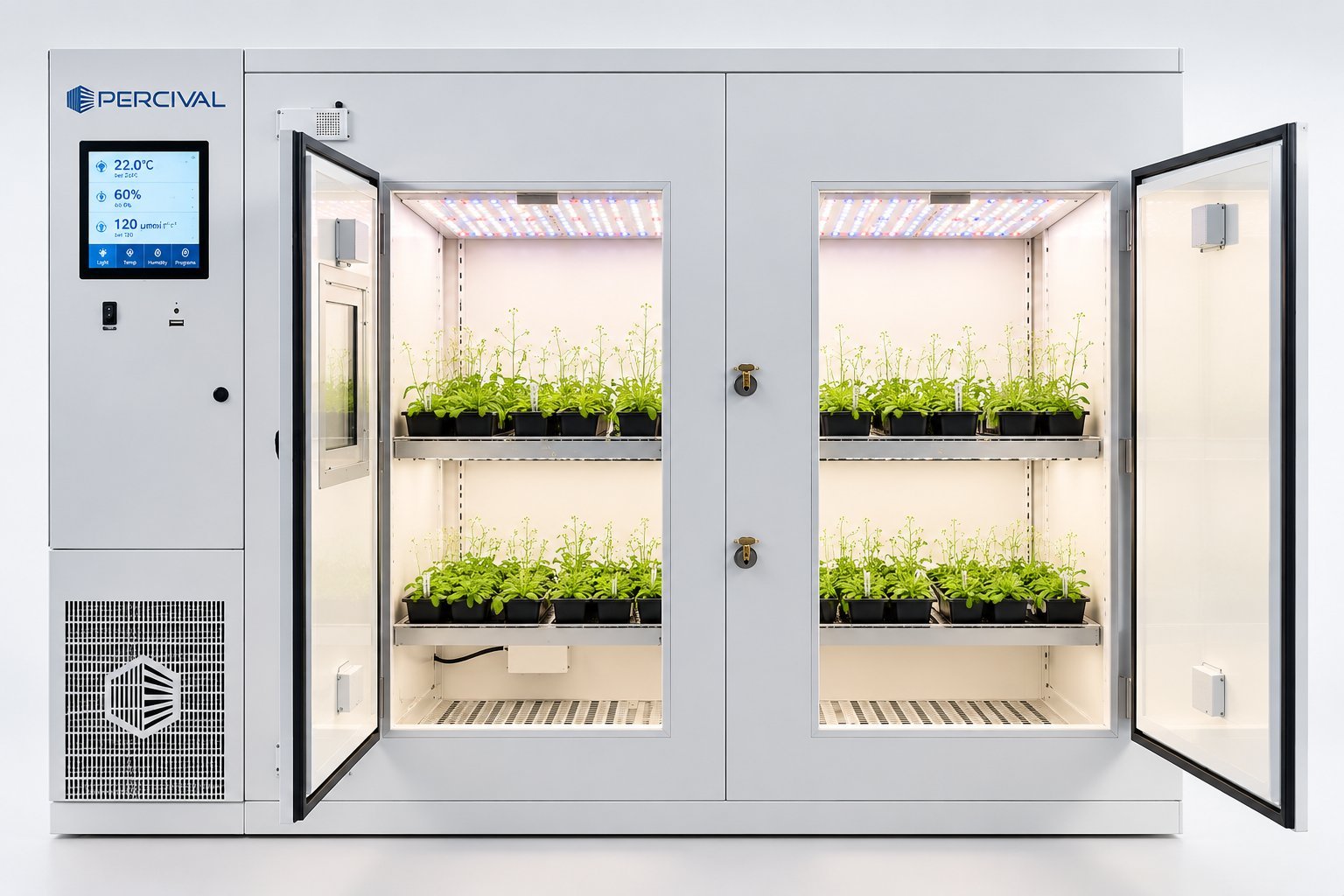
Plant Growth Research in Controlled-Environment Chambers
- Growth and development of crops and model plants
- Heat, cold and drought stress
- Elevated CO₂ and climate scenarios
- Photoperiod and flowering
- Seedling and transplant production
Conditions That Decide Plant Growth Results
| Parameter | Why it matters | What to specify |
|---|---|---|
| Light intensity (PPFD) | Drives photosynthesis and growth rate; too little gives elongated, weak plants | Target µmol/m²/s at plant height, and whether it must be dimmable |
| Light spectrum | Red, blue and far-red balance shapes flowering, height and leaf development | White LED, white enriched with red, or multi-colour dimmable LEDs |
| Photoperiod | Controls flowering in day-length-sensitive species | Day length and any ramps for dawn and dusk |
| Temperature | Sets development rate; day–night differences affect height and yield | Day and night set points, with lights on and off, and any ramps |
| Relative humidity | Affects transpiration, disease and stomatal behaviour | Range needed, and whether active humidification or dehumidification is required |
| CO₂ | Raises photosynthesis; elevated CO₂ is used in climate studies | Ambient, enriched or controlled set point |
| Growing height and area | Limits plant size and replication | Shelf area, number of tiers and clear height to the lamps |
Getting Reliable Results from Growth Chambers
Replicate across time or chambers
Rotate plant positions
Measure, do not assume
Match the root zone
Plan for plant height
Recommended Equipment for Plant Growth Research
Catalogues and Compliance Documents
Frequently Asked Questions
What light intensity do I need for crop plants?
Many crops grown for research need considerably more light than Arabidopsis, and high-light cereals benefit from chambers that reach high intensities at plant height. The JKG-66 delivers up to 1,200 µmol/m²/s as standard and LED configurations reach 2,100 µmol/m²/s or higher. Tell us the species and target and we will size the lighting.
Why is light measured at a specific distance?
Light falls with distance from the lamps, so intensity figures are only comparable at a stated distance. Measure at plant height with a quantum sensor such as a PSI SpectraPen and record it in your methods.
How many chambers does my experiment need?
Each chamber holds one set of conditions. If you need to compare temperatures, CO₂ levels or photoperiods at the same time, you need one chamber per condition, plus replication over time or across chambers to separate treatment from chamber effects.
Do I need humidity control?
For heat, drought and pathology studies, and whenever vapour pressure deficit matters, yes. For routine growth it is often optional. Specify the range you need with lights on and off.
Can I simulate field weather?
Yes. Percival’s WeatherEze feature simulates real-time, historical and climate-change weather on chambers with the IntellusUltra controller.
Reach-in chamber or walk-in room for growth studies?
Reach-in chambers suit several experiments with different conditions; walk-in rooms suit large plant numbers or tall crops under one condition. See reach-in chambers and walk-in growth rooms.