
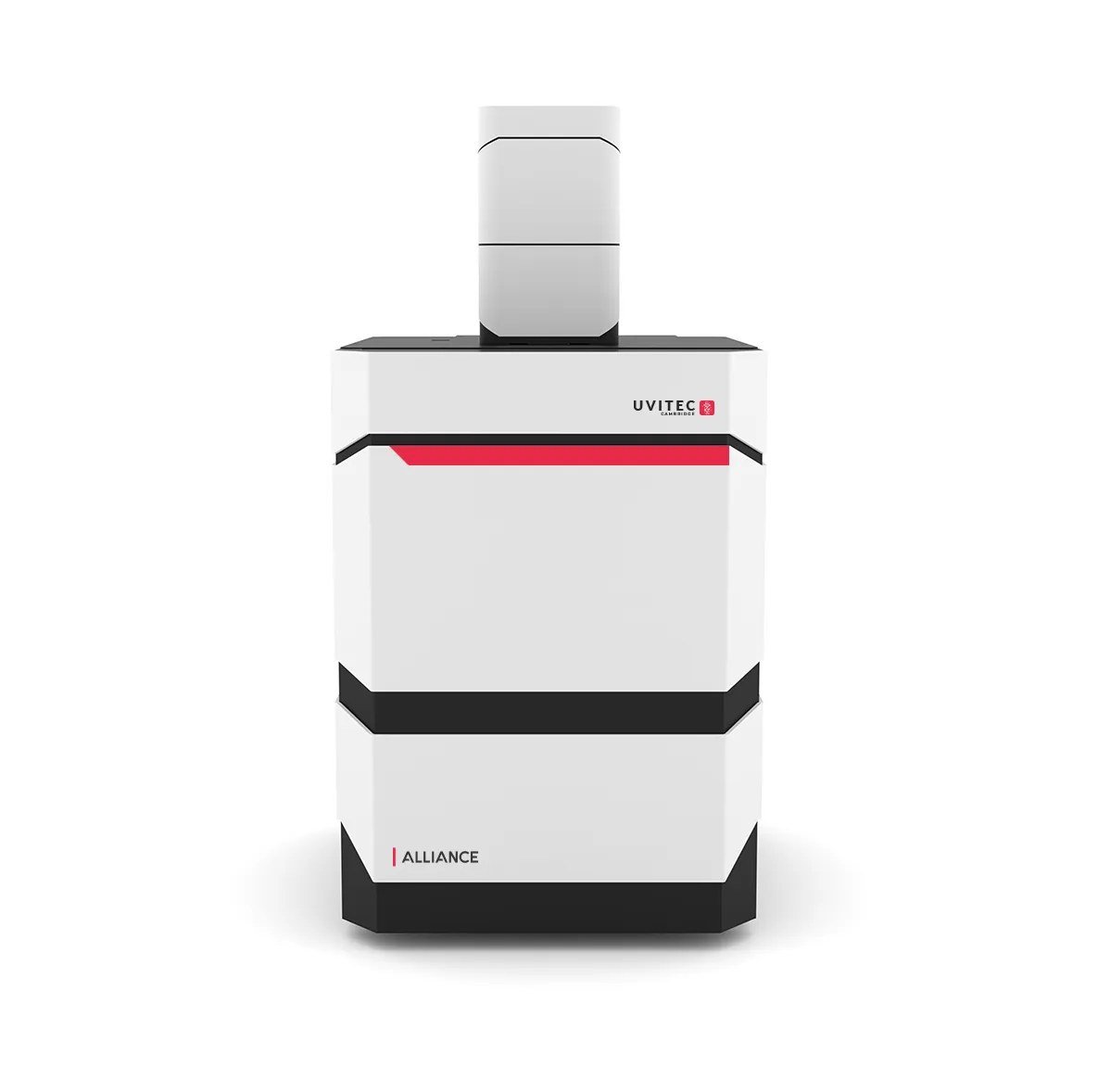
Western Blot Imaging: The UVITEC Alliance Range
UVITEC Alliance imagers for chemiluminescent and fluorescent western blots, supplied, installed and serviced by JKG. What sets them apart from X-ray film and entry-level imagers:
- Cooled 9.2 MP scientific cameras (regulated cooling to −60 °C on the Alliance Q9) for long, low-noise exposures of weak bands.
- Very fast f/0.75 and f/0.80 custom lenses that collect more light, so exposures are shorter.
- 4.8 OD dynamic range with 65,535 grey levels, so weak and strong bands are quantified in the same image without saturation.
- Multiplex fluorescence up to the near-infrared (Cy7, IRDye 800) with optional epi-fluorescence modules.
- One instrument for blots and gels: interchangeable UV, blue and white transilluminators also cover DNA and protein gels.
- Cooled 9.2 MP camera, up to 30 MP extended
- f/0.75 and f/0.80 custom lenses
- 4.8 OD dynamic range
- Chemiluminescence, fluorescence and gels
- No film, developer or darkroom
- GLP and 21 CFR Part 11 compliant
UVITEC Alliance Systems We Supply
Chemiluminescence imaging: Alliance Q9 and Q9 Advanced
Top-end multiplex imaging: Alliance IRIS
UVITEC Alliance Specifications
Alliance Q9
Alliance Q9 Advanced
Alliance IRIS
| Model | Camera | Lens | Dynamic range | Fluorescence | Operation |
|---|---|---|---|---|---|
| Alliance Q9 | 9.2 MP (up to 18 MP), −60 °C regulated cooling | f/0.80 custom lens | 4.8 OD; 65,535 grey levels | Optional epi-fluorescence; 7-position filter wheel, up to 18 filters | Manual settings, PC-operated |
| Alliance Q9 Advanced | 9.2 MP native, 18 MP extended | f/0.80 panoramic lens; 24 × 20 cm field of view | 65,535 grey levels | Chromapure module, up to 7 excitation channels | Automatic or manual, PC-operated |
| Alliance IRIS | 9.2 MP native, 30 MP extended; three-stage Peltier cooling to −30 °C | f/0.75 custom lens; motorised auto-focus | 4.8 OD | Chromascan, up to 12 packs, 365 to 780 nm | 15.6-inch HD touch screen (stand-alone) or PC-operated |
Specifications as published by UVITEC Cambridge. Configurations vary; we confirm the exact specification in the quotation.
Why Laboratories Choose UVITEC Alliance
Sensitivity for weak bands
True quantification
Multiplex fluorescence
Blots and gels in one
Upgradeable
Compliant software
Typical Uses
How to Choose a Western Blot Imager
If your blots are chemiluminescent (ECL) and budgets are tight, the Alliance Q9 gives cooled-camera sensitivity with room to add fluorescence later. For busy shared labs, the Q9 Advanced adds automatic operation and multi-channel fluorescence. If you run multiplex or near-infrared blots regularly, or want a stand-alone touch-screen system, choose the Alliance IRIS. If you only image DNA and protein gels, a gel documentation system is the more economical choice.
- Epi-fluorescence modules (Chromapure, Chromascan)
- UV, blue and white transilluminators
- Emission filters for fluorescent dyes
- Epi-UV lighting for TLC plates and Qdots
- Touch-screen or PC-operated configurations
Catalogues and Compliance Documents
Catalogues, technical specifications and compliance documents for UVITEC Alliance systems are available on request for institute purchases and tenders.
Frequently Asked Questions
Answers to the questions we hear most about western blot imaging systems.
Which UVITEC western blot imagers does JKG supply?
The UVITEC Alliance series: Alliance Q9, Alliance Q9 Advanced and Alliance IRIS. All image chemiluminescent western blots; fluorescence and gel imaging are added with optional modules and transilluminators.
Why move from X-ray film to a digital chemiluminescence imager?
Film saturates quickly, so strong bands cannot be quantified against weak ones, and it needs a darkroom, developer and repeated exposures. A cooled camera with a 4.8 OD dynamic range records weak and strong bands in one image, in normal room light, with no film or chemicals to buy.
Can the Alliance systems image fluorescent western blots?
Yes, with the optional epi-fluorescence modules. UVITEC lists dyes from DyLight 405 and Alexa 405 through Cy3 and Cy5 to Cy7 and IRDye 800, so two or more targets can be detected on one blot.
Can the same system image DNA and protein gels?
Yes. Interchangeable transilluminators (UV, blue and white) let the Alliance systems image ethidium bromide and safe-stain gels, Coomassie and silver-stained protein gels and colony plates, so one instrument can replace a separate gel doc.
What is the difference between the Alliance Q9 Advanced and the Alliance IRIS?
Both use a 9.2 MP camera. The Q9 Advanced has an f/0.80 lens and the Chromapure fluorescence module with up to 7 excitation channels. The IRIS has a faster f/0.75 lens, the Chromascan module with up to 12 packs from 365 to 780 nm, LED sample tables and a 15.6-inch touch-screen option.
Is the software suitable for regulated laboratories?
UVITEC states that its acquisition and analysis software is GLP and 21 CFR Part 11 compliant, with customisable protocols and unlimited users.
Do you install and service the systems?
Yes. JKG installs the system, trains your users and provides service and spare-parts support, along with quotations and compliance documents for institute and tender purchases.