
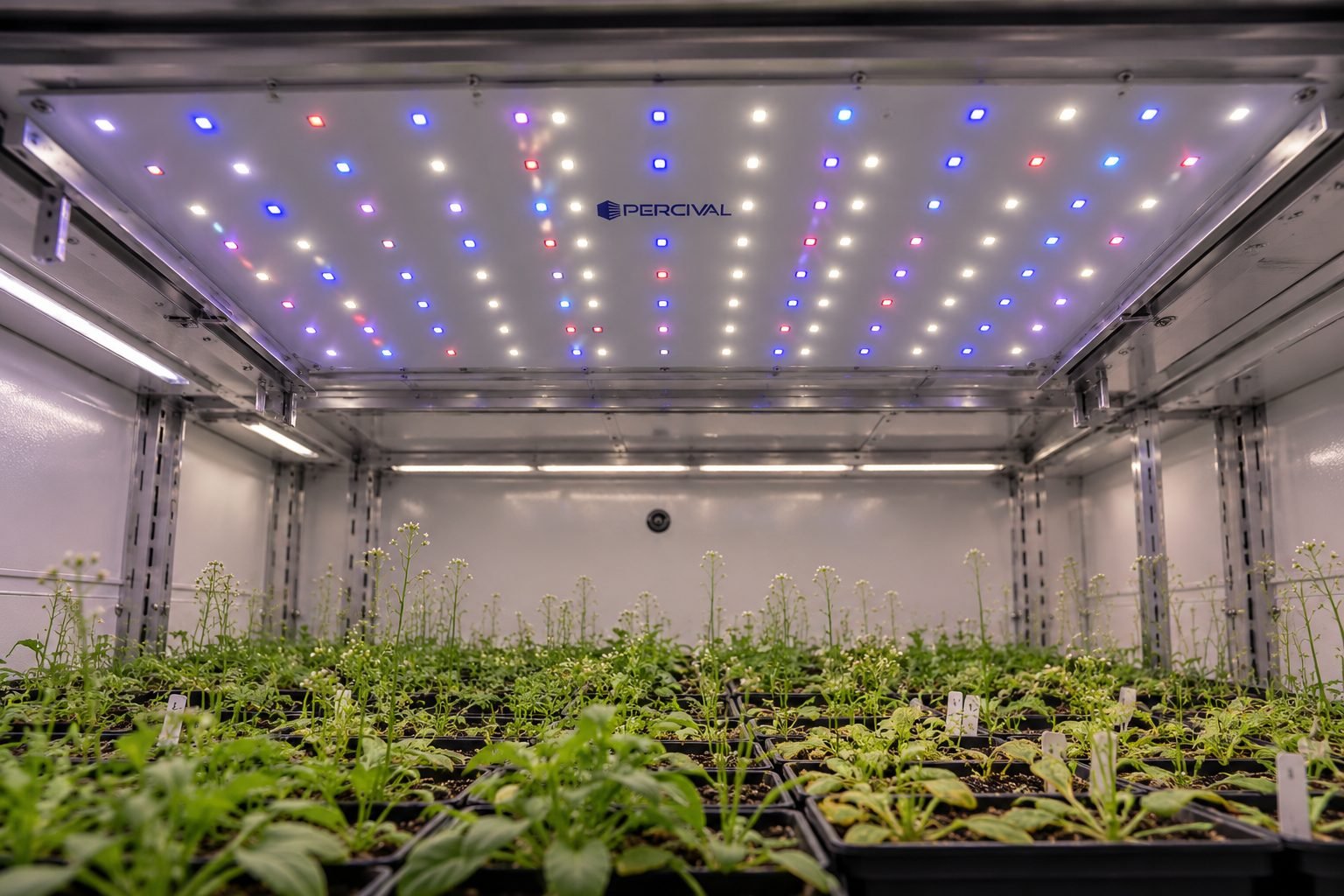
Arabidopsis Research: Growing Model Plants Under Controlled Conditions
- Mutant screens and genetics
- Flowering time and photoperiod
- Abiotic stress responses
- Plant–pathogen interactions
- Seed production and bulking
- Gene expression under defined conditions
Typical Arabidopsis Growth Conditions
| Parameter | Commonly used range | Notes |
|---|---|---|
| Temperature | 20–22 °C, often 2–4 °C cooler at night | Small temperature differences change flowering time and rosette size |
| Light intensity | About 100–150 µmol/m²/s at rosette level | Higher light for some photosynthesis and stress studies; keep it uniform across the tier |
| Photoperiod | Long days (16 h light) for flowering; short days (8–10 h) for large vegetative rosettes | Day length strongly controls flowering time |
| Relative humidity | Around 60–70% | Very low humidity stresses seedlings; very high favours pests and disease |
| Seed stratification | 2–4 days at about 4 °C in the dark | Synchronises germination before plants move to growth conditions |
| Vernalisation | Several weeks at about 4 °C for late-flowering accessions | Needs a chamber that holds low temperature reliably |
What Most Often Compromises Arabidopsis Experiments
Uneven light
Temperature drift
Mixed photoperiods
Humidity extremes
Crowding
Recommended Equipment for Arabidopsis Research
Humidity option
Catalogues and Compliance Documents
Frequently Asked Questions
What growth conditions does Arabidopsis need?
Most laboratories grow Arabidopsis at about 20–22 °C, 100–150 µmol/m²/s and 60–70% relative humidity, under long days for flowering or short days for vegetative growth. Exact conditions depend on the accession and the experiment.
Why do my Arabidopsis plants flower at different times?
Flowering responds to temperature, photoperiod and light intensity. Uneven light across a shelf, warm spots near lamps or drifting temperature all change flowering time, which is why uniform, well-controlled chambers matter.
Do I need a dedicated Arabidopsis chamber?
Arabidopsis chambers have low tiers with even, moderate lighting, so more plants fit per chamber. Multi-application chambers such as the JKG-41 AR can also be configured for Arabidopsis. See Arabidopsis chambers for models.
How many tiers should I choose?
Two tiers give more height for flowering plants and siliques; three tiers give more shelf area for rosettes and seedlings. Dimmable tiers let you run two light levels at once.
Can I vernalise plants in the same chamber?
Arabidopsis chambers control temperature down to 7 °C. For long vernalisation at about 4 °C, use a separate low-temperature chamber or incubator so growth experiments are not interrupted.
How do I keep thrips and fungus gnats out?
Start with clean soil and seed, avoid over-watering, keep humidity moderate and clean chambers between runs. Sticky traps help detect problems early.