
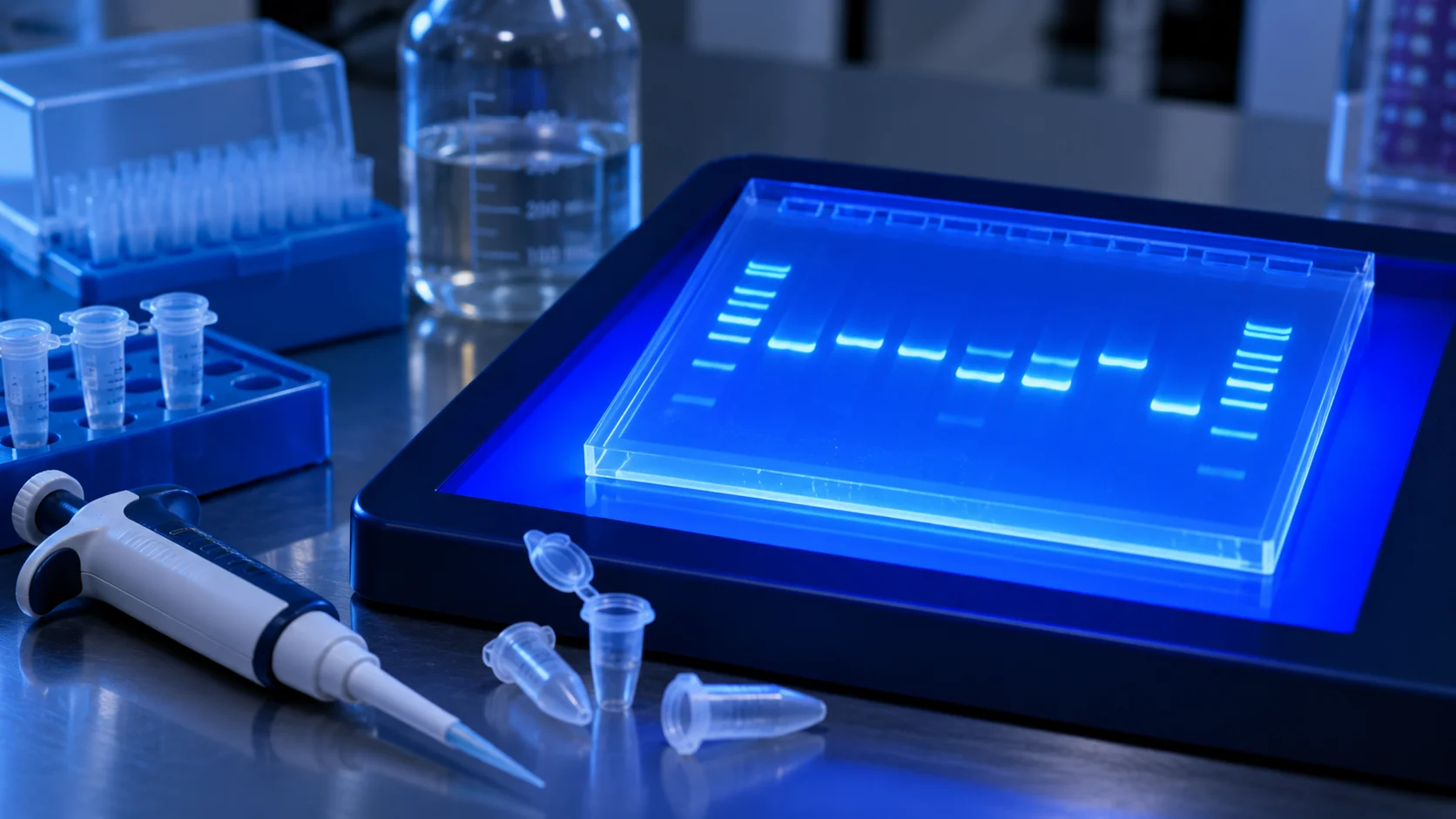
Molecular Biology and Imaging: From Sample to Quantified Result
- DNA and RNA gel documentation
- PCR and cloning checks
- Protein gels
- Chemiluminescent western blots
- Fluorescent and multiplex blots
- Nucleic acid and protein quantification
Imaging Modes and When to Use Them
| Imaging mode | Typical samples | What the system needs |
|---|---|---|
| UV transillumination | DNA and RNA gels stained with ethidium bromide and similar dyes | UV transilluminator, emission filter, sensitive camera |
| Blue-light or visible excitation | Gels stained with safer, blue-light-excited dyes | Blue or visible light source and matching filter |
| White light (epi or trans) | Coomassie and silver-stained protein gels, colorimetric blots, plates | White-light illumination |
| Fluorescence | Fluorescent protein stains, fluorescent western blots, multiplex detection | Several excitation sources and emission filters |
| Chemiluminescence | HRP-based western blots, replacing X-ray film | Cooled, high-sensitivity camera in a dark enclosure, long exposures |
Equipping the Molecular Biology Workflow
Getting Publication-Quality Gel and Blot Images
Avoid saturation
Match light and filter to the dye
Protect users from UV
Catalogues and Compliance Documents
Frequently Asked Questions
Which imaging system do I need for my lab?
For DNA and RNA gels only, a compact UV gel documentation system is usually enough. Fluorescent stains and blots need a multi-application imager; chemiluminescent western blots need a cooled-camera system such as the UVITEC Alliance Q9 series. See UVITEC.
Can a gel doc system replace X-ray film for western blots?
A cooled-camera chemiluminescence imager can, and gives quantitative digital images without a darkroom or film processing.
How do I get quantitative band data?
Use a 16-bit camera, avoid saturated pixels, keep exposure within the linear range and include a standard curve or loading control. UVITEC systems use 16-bit cameras for quantitative analysis.
Is blue-light imaging safer than UV?
Blue-light excitation avoids UV exposure for users and reduces DNA damage when bands will be excised for cloning. It needs a compatible stain.
What else does a molecular biology lab need?
Centrifuges for extraction and purification, balances for reagent preparation and a UV-Vis spectrophotometer for nucleic acid and protein quantification, all of which JKG supplies.