
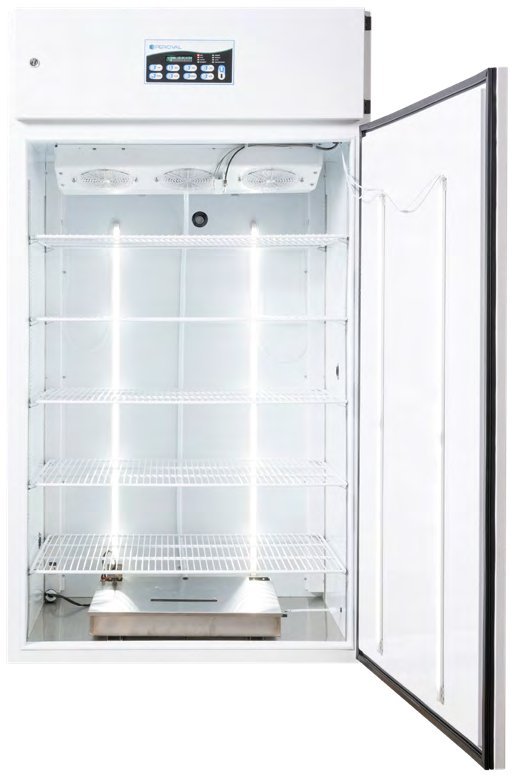
Drosophila and Insect Research: Rearing Chambers and Incubators
- Drosophila stock maintenance
- Genetic crosses and screens
- Circadian rhythm and sleep studies
- Developmental and toxicology assays
- Insect rearing for entomology and pest research
- Temperature-tolerance studies
What Drosophila and Insect Rearing Needs
| Condition | Typical setting | Why it matters |
|---|---|---|
| Temperature | 25 °C for rearing; 18 °C to slow stocks | Sets development time; small drifts change generation length and phenotypes |
| Humidity | Around 60% RH | Prevents food and media drying; low humidity reduces survival |
| Light | 12 h light : 12 h dark, or constant dark | Entrains circadian rhythms; needed for behaviour and sleep studies |
| Air and hygiene | Clean airflow, easy cleaning, mite control | Mites and moulds spread quickly between stocks |
| Containment | Insect screen on air paths | Keeps escaped insects out of the refrigeration system and the lab |
Percival Drosophila and Insect Chambers
| Model | Tiers | Light (µmol/m²/s) | Temperature (°C) | Volume (m³) | Shelf area (m²) | Max. height (cm) | Exterior W × D × H (cm) |
|---|---|---|---|---|---|---|---|
| DR-36NL | 6 | No light | 2–44 ± 0.5 | 0.8 | 3 | 20.3 | 85.1 × 85.4 × 196.1 |
| DR-36VL | 5 | 120 | 5–44 ± 0.5 | 0.8 | 2.5 | 24.1 | 85.1 × 85.4 × 196.1 |
| DR-41NL | 6 | No light | 2–44 ± 0.5 | 1.1 | 3.8 | 20.3 | 104.1 × 85.4 × 196.1 |
| DR-41VL | 5 | 120 | 5–44 ± 0.5 | 1.1 | 3.2 | 24.1 | 104.1 × 85.4 × 196.1 |
| TE-36VL (thermoelectric) | 5 | 120 | 13–45 ± 0.5 | 0.8 | 2.3 | 27.9 | 85.1 × 99.8 × 196.1 |
How to Choose a Chamber for Insect Work
Stock keeping or experiments
Cabinet size
Thermoelectric option
Containment
Catalogues and Compliance Documents
Frequently Asked Questions
What temperature and humidity do Drosophila stocks need?
Most labs rear Drosophila melanogaster at about 25 °C, where a generation takes roughly ten days, and keep long-term stocks at 18 °C to slow development. Humidity around 60% keeps food from drying out. A chamber that holds ±0.5 °C keeps development times consistent between generations.
Why not use an ordinary BOD incubator for flies?
Fly food and rearing vials create an acidic, humid environment that corrodes standard coils and components. Percival DR chambers carry a protective coating and come standard with additive humidity, so they last longer under these conditions.
NL or VL: which do I need?
NL (no light) suits stock maintenance and dark incubation from 2 °C. VL adds vertical IncuWhite LED lighting at 120 µmol/m²/s for experiments that need a light–dark cycle, such as circadian and behaviour studies.
Can the same chamber rear other insects?
Yes. Percival lists insect and amphibian studies among the applications of its lighted incubators, and an air filter assembly (insect screen) is available as an option. Tell us the species and conditions and we will recommend a model.
Can I observe insects without disturbing them?
Insects cannot see red light. IncuBrite supplemental LEDs can add a red spectrum so insects are not made overly active or agitated during observation.
What if I need space for a large colony?
Walk-in rooms are built to any size with controlled temperature, humidity and lighting for large colonies and shared insectaries. See walk-in growth rooms.