
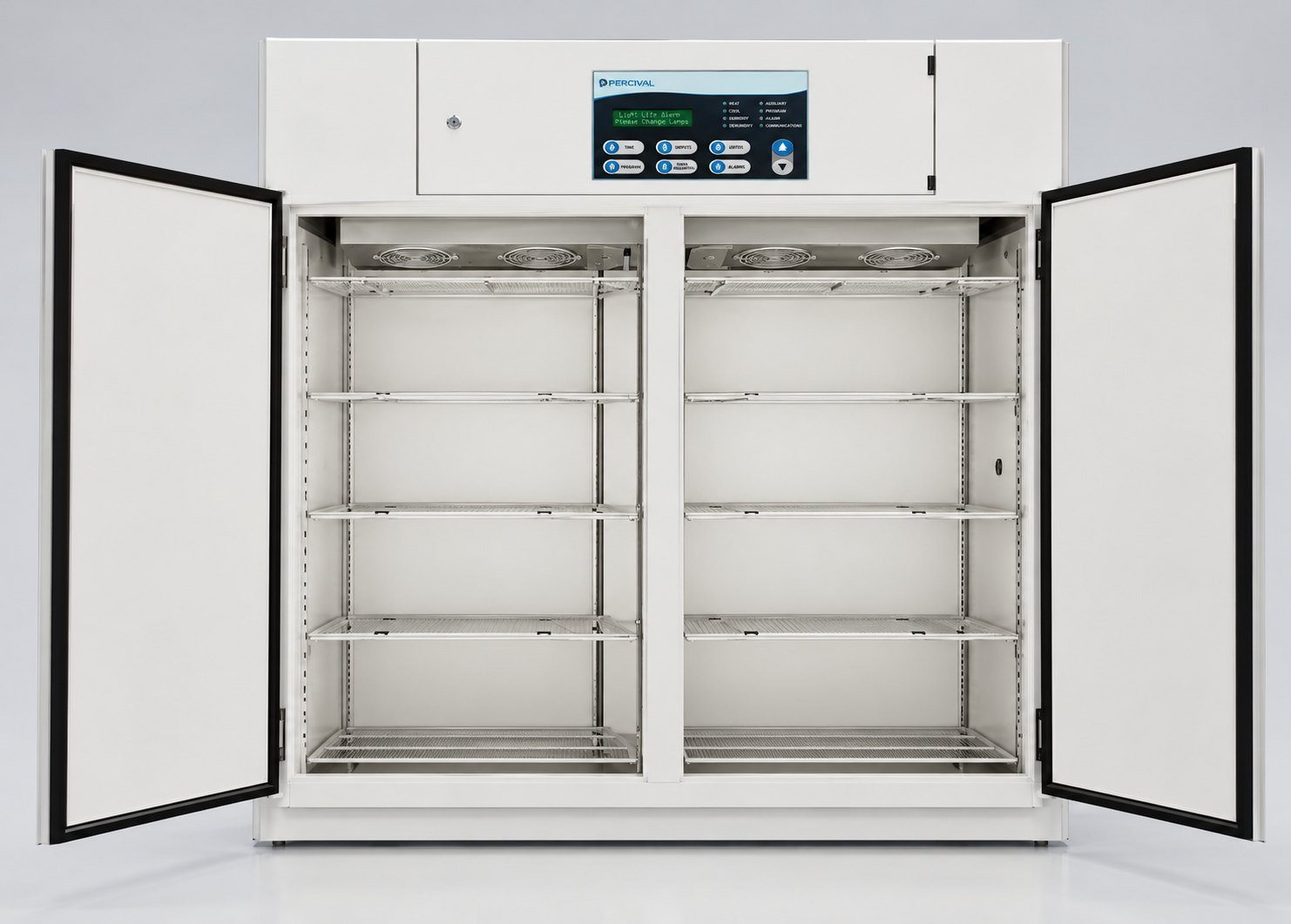
Buying guide · Updated October 2026
A plant growth chamber is a long-term instrument. A well-chosen chamber runs reliable experiments for well over a decade; a poorly chosen one limits every project that uses it. Most problems we see in Indian labs do not come from a faulty chamber. They come from a chamber that was specified for the wrong experiment: too little light for the crop, no humidity control during the monsoon, or a cabinet that will not fit through the laboratory door.
This guide walks through the decisions in the order we recommend making them, with the numbers you need at each step. It is written for principal investigators, research scholars, facility managers and purchase committees at ICAR institutes, agricultural universities, CSIR and DBT laboratories, IITs, IISERs and seed companies.
The short answer
Choose a growth chamber by working through these questions, in this order:
- What will you grow, and under what conditions? Write down light intensity, photoperiod, day and night temperature, humidity and CO₂ for your most demanding experiment.
- How many plants, how tall, and how many separate treatments? This decides reach-in or walk-in, shelf area and growing height.
- Can the chamber hold your conditions with the lights on? Check light at plant level, temperature range with lights on, and humidity range at your temperature.
- Can you record and prove the conditions? Check the controller, data logging, alarms and remote access.
- Is your room ready? Check space, door width, power, ambient temperature, heat removal and water.
- Who will install, validate and service it in India? Check engineers, spares, response time and documentation.
On this page
1. Start with the experiment, not the catalogue
Before comparing models, write down the conditions your plants need. Use your most demanding planned experiment, not your average one: a chamber that can run a 22-hour speed-breeding cycle at high light can also grow Arabidopsis, but the reverse is not true.
The table below gives typical starting points from published protocols and common laboratory practice. Your own protocol always takes priority.
| Application | Light at plant level (PPFD) | Photoperiod | Temperature (day / night) | What to look for |
|---|---|---|---|---|
| Arabidopsis, standard growth | 100–150 µmol/m²/s | 16 h light (long day); short-day work uses 8–10 h | 22 °C / 18 °C | Very even light across shelves, low air speed, humidity control. See Arabidopsis chambers. |
| Speed breeding (wheat, barley, chickpea, canola) | About 450–500 µmol/m²/s | 22 h light, 2 h dark | 22 °C / 17 °C | High light that stays on 22 h a day, enough cooling to remove the extra heat, tall growing height. |
| Crop physiology and stress (rice, maize, millets, pulses) | Often 600–1,500 µmol/m²/s or more | Per protocol (often 12–14 h) | Per protocol, including heat-stress set points | High-output LED, wide temperature range with lights on, humidity control at high temperature. |
| Seedlings, germination, tissue culture | Low (tens of µmol/m²/s up to about 100) | Often 16 h | Usually 22–25 °C | Multiple shelves, even temperature, low cost per shelf. |
| Cold acclimation, vernalisation, low-temperature studies | Per protocol | Per protocol | Near or below 4 °C | A model rated for low temperatures with lights on, and defrost control. |
| Algae and cyanobacteria | Typically low to moderate | Continuous or per protocol | Per strain | Even light from the side or top, space for flasks or photobioreactors. See algae chambers. |
| Drosophila and insects | Low | Commonly 12 h light / 12 h dark | Commonly 25 °C (often 18 °C for stocks) | Tight temperature stability, humidity control, shelves for vials and cages. See insect chambers. |
Arabidopsis values follow the Purdue University plant growth facility summary; speed-breeding values follow Ghosh et al. (2018), Nature Protocols. Other rows are typical ranges, not fixed requirements.
Two more questions belong at this stage:
- How many independent treatments run at the same time? One chamber can only hold one climate. If you need to compare three temperatures at once, you need three chambers (or one chamber with separately controlled compartments). Several smaller chambers also give genuine replication: treatments in separate chambers are independent, while plants in one chamber share its climate.
- How will the work change over the next five to ten years? Chambers outlast projects. If a phenotyping, speed-breeding or climate-change project is likely, specify for it now.
2. Reach-in chamber or walk-in room?
A reach-in chamber is a self-contained cabinet that you load from the front. A walk-in growth room is a room built from insulated panels, with space to walk in and work among the plants.
| Question | Reach-in chamber | Walk-in room |
|---|---|---|
| Plant numbers | Small to medium experiments, one or more shelves | Large populations, breeding lines, whole trays of crop plants |
| Plant height | Short to medium plants, or tall plants in single-tier models | Tall crops to maturity, multi-tier shelving for smaller plants |
| Parallel treatments | Easy: buy several chambers, each with its own climate | One climate per room, unless the room is divided |
| Installation | Delivered as a unit; needs a suitable room, power and access | Built on site; needs floor space, power, heat rejection and planning |
| Flexibility later | Can be moved to another lab | Fixed to the building, but can be reconfigured inside |
| Typical users | Arabidopsis and model plants, gene-function work, stress studies, seedlings, insects | Speed breeding, crop physiology, pre-breeding, phenotyping programmes |

A useful rule: if your plants and trays fit on the shelves of two or three reach-in chambers, reach-ins usually give more flexibility for the money. If you need several square metres of growing area under one climate, or plants taller than a cabinet allows, a walk-in room is the better fit. Standard walk-in configurations cover roughly 4 to 23 m² of growing area, and larger rooms can be built to order.
For very tall plants, check the usable growing height, not the external height. It is measured from the shelf or floor to the lamps, and lamp position matters for light intensity (see below).
3. Light: ask for the number at plant level
Light is the specification most often misunderstood. Plants respond to photosynthetic photon flux density (PPFD), measured in µmol/m²/s across 400–700 nm. Lamp wattage tells you very little.
Questions to ask about light
- At what distance was PPFD measured? Light falls off quickly with distance from the lamps. A figure measured 15 cm below the lamps will be much higher than the light at the top of a 60 cm plant. Ask for PPFD at the height where your canopy will be.
- How even is it? Ask for the minimum and maximum across the shelf, not only the centre reading. Uneven light means plants at the edges grow differently, which adds variation to your data.
- Can it be dimmed and ramped? Dimmable LEDs let you match each protocol and simulate dawn and dusk.
- What spectrum? White LED suits general growth. Some studies need added far-red, blue or UV, or separately controllable channels. See specialized lighting chambers.
- Is the light heat removed? All lamps add heat. The chamber must be able to remove it and still hold your temperature (see section 4).
Use daily light integral (DLI) to compare protocols
Daily light integral is the total light a plant receives in a day:
DLI (mol/m²/day) = PPFD × hours of light × 0.0036
For example, Arabidopsis at 150 µmol/m²/s for 16 hours receives about 8.6 mol/m²/day. A speed-breeding cycle at 450 µmol/m²/s for 22 hours delivers about 35.6 mol/m²/day, roughly four times as much. A chamber chosen for the first will not run the second.
LED or fluorescent?
LED is now the standard choice for new chambers. It produces less heat for the same light, lasts longer, can be dimmed, and allows spectrum control. Modern LED chambers can reach very high intensities: LED lighting in our reach-in range can be configured to 2,100 µmol/m²/s or higher. Fluorescent lamps are cheaper at the start but lose output with age and need regular replacement.
4. Temperature: check the range with the lights on
A chamber’s temperature range is often quoted with the lights off. Under full light the lowest achievable temperature rises, because the cooling system must also remove the heat from the lamps. Always ask: what is the temperature range with the lights at full intensity?
- Range. Cover your coldest and hottest set points, including heat-stress or cold-acclimation treatments. Chambers in our reach-in range go up to 44 °C, and low-temperature (LT) models go down to −10 °C.
- Stability (control). How closely the chamber holds the set point over time at the sensor. Good reach-in chambers hold about ±0.5 °C.
- Uniformity. How much temperature varies from place to place inside the chamber. This is different from stability and matters just as much. Ask for it.
- Day and night programs. Most protocols use different day and night temperatures. The controller should change them on a schedule, ideally with gradual ramps.
- Recovery after door opening. How quickly conditions return after you open the door to water or measure plants.
5. Humidity: essential in Indian conditions
Many chambers are sold without active humidity control. In India that is a risk. Ambient humidity swings from very dry winters and pre-monsoon months to near-saturation during the monsoon, and those swings reach your plants through the chamber’s fresh-air exchange and the room around it.
- Ask for the humidity range at your temperature. Humidity ratings depend on temperature and light. A figure quoted at one temperature may not hold at another.
- Check both directions. Adding moisture (humidification) and removing it (dehumidification) are separate functions. High-humidity set points at low temperatures, and low-humidity set points with full lights, are the hardest.
- Plan the water supply. Humidifiers need clean water (usually RO or deionised) to avoid scale on sensors and coils. Plan a supply or reservoir at the time of installation.
- Consider vapour pressure deficit (VPD). Plant transpiration depends on VPD, which combines temperature and humidity. Many researchers now report VPD alongside relative humidity.
6. CO₂ control: only if your science needs it
CO₂ enrichment or control is needed for elevated-CO₂ and climate-change studies, and it helps keep CO₂ steady in closed rooms full of plants. It adds a sensor, a gas supply (cylinder or line) and safety requirements for the room. If you only need to monitor CO₂, a sensor with logging may be enough. Decide early, as adding full control later costs more.
7. Controller and data: can you prove your conditions?
Journals and reviewers increasingly expect the growing conditions to be measured and reported, not just the set points. The International Committee for Controlled Environment Guidelines (ICCEG) recommends reporting light (PPFD, with range), air temperature and humidity for light and dark periods, air velocity, and CO₂, measured at the top of the plant canopy.
Look for a controller that:
- Runs multi-step programs (photoperiod, temperature, humidity and light ramps) without manual changes.
- Logs conditions continuously and exports them in a usable format such as CSV.
- Sends alarms when conditions drift or power fails, by email or on a phone.
- Allows remote monitoring over the institute network.
- Restarts the program safely after a power cut.
Chambers that log conditions this precisely are also the foundation for image-based phenotyping. See AI-ready plant research.
8. Site and utilities: prepare the room before you order
Installation problems are expensive to fix after delivery. Check these points with your supplier and your estate or engineering department before the purchase order:
- Access. Measure doors, corridors, lifts and turns on the route to the room. Large reach-in chambers may need a minimum door width or partial dismantling.
- Space and clearance. Leave the clearance the manufacturer specifies behind and around the chamber for airflow and service access.
- Room temperature. Chambers reject heat into the room, and their performance is specified for a given ambient range. A non-air-conditioned room in an Indian summer can push a chamber beyond its design limits. An air-conditioned room is strongly recommended.
- Heat rejection for walk-ins. Walk-in rooms with high light produce a lot of heat. Plan where the condensing units will go and how heat will leave the building.
- Power. Confirm the voltage, phase and current rating, a dedicated circuit, and earthing. Where the supply fluctuates, a suitable voltage stabiliser protects the compressor and electronics. Decide what should happen during power cuts.
- Water and drainage. Plan RO or deionised water for humidifiers and a drain for condensate.
- Network. Provide a network point if you want remote monitoring and alarms.

9. Installation, validation and service in India
A growth chamber is only as good as the support behind it. For imported equipment, local service capability matters as much as the specification sheet.
- Installation and commissioning by trained engineers, with a demonstration that the chamber meets its specification in your room.
- A performance check at handover. Ask for measured light, temperature and humidity values, ideally at several points, so you have a baseline for later.
- User training for the people who will run experiments, not only the facility in-charge.
- Response time and spares. Ask where engineers are based, how quickly they respond, and which spares are stocked in India.
- Preventive maintenance and AMC. Regular cleaning, sensor calibration and refrigeration checks keep a chamber accurate for many years.
- Installed base. Ask for a list of similar installations, and speak to existing users.
Read more about JKG’s installation and commissioning and annual maintenance contracts.
10. Budget and running cost
Compare the total cost over the chamber’s life, not only the purchase price:
- Electricity. Lighting and cooling run for many hours a day. LED reduces both lamp power and the cooling needed to remove lamp heat.
- Lamps and consumables. Fluorescent tubes need regular replacement; LEDs last far longer. Humidifier water treatment and filters are recurring costs.
- Service. Factor in an AMC after warranty.
- Downtime. A failed chamber can cost a full growing season. Reliability, alarms and fast service have real value.
- Room preparation. Air conditioning, electrical work and water supply belong in the budget.
11. Writing a tender or GeM specification
For government purchases, a clear specification protects both the institute and the bidders. Our suggestions:
- Specify performance, not a brand. State PPFD at a stated distance or canopy height, temperature range with lights on, humidity range at stated temperatures, stability, uniformity, and logging requirements.
- State the growing area and usable height you need, rather than an exact external size.
- Ask for evidence. OEM authorisation, product catalogues and datasheets, an installation list and performance certificates make evaluation easier. JKG provides these on request; see tender documents.
- Include installation, training and warranty terms, and an AMC option, so bids are comparable.
- Describe the site (room size, door width, power) so suppliers can confirm feasibility before bidding.
12. Checklist: questions to ask every supplier
- What is the PPFD at my canopy height, and what are the minimum and maximum across the shelf?
- What is the temperature range with the lights at full intensity?
- What humidity range can the chamber hold at my day and night temperatures?
- What are the temperature stability and uniformity specifications?
- What is the usable growing height and shelf area?
- Can the controller run my full day/night program, log data and send alarms?
- What does the room need: space, clearance, ambient temperature, power, water, drainage?
- Who installs and services it in India, how quickly, and which spares are stocked?
- What is measured and documented at handover?
- Can I speak to users with the same model?
Frequently asked questions
How much light does Arabidopsis need in a growth chamber?
A common standard is 100–150 µmol/m²/s at plant level with a 16-hour photoperiod at 22 °C day and 18 °C night, as summarised by the Purdue University plant growth facility. Many labs use shorter photoperiods (8–10 hours) to keep plants vegetative.
Can a standard growth chamber run speed breeding?
Only if it can deliver enough light for 22 hours a day and remove the extra heat. The published protocol by Ghosh et al. (2018) uses about 450–500 µmol/m²/s at canopy height, 22 hours of light and 22 °C / 17 °C. Check the light at your canopy height and the temperature range with lights on before choosing a chamber for speed breeding.
What is the difference between a growth chamber and an incubator?
An incubator controls temperature, and sometimes humidity, usually in the dark or under low light. A plant growth chamber adds controlled lighting strong enough for photosynthesis, a programmable photoperiod, and airflow designed for plants, along with humidity and sometimes CO₂ control.
Should I buy one large chamber or several smaller ones?
Several smaller chambers let you run different treatments at the same time and give independent replicates. One large chamber or room gives more growing area under a single climate. Many labs combine both.
How do I calculate daily light integral (DLI)?
Multiply PPFD (µmol/m²/s) by the hours of light per day and by 0.0036. For example, 300 µmol/m²/s for 14 hours gives about 15.1 mol/m²/day.
Do I need humidity control?
For most plant work in India, yes. Seasonal swings in ambient humidity affect transpiration, disease and growth. Active humidification and dehumidification keep conditions stable year-round and make experiments repeatable.
Talk to us about your experiment
JKG BioScience has supplied and serviced research equipment in India since 2003 and is the authorised Indian distributor of Percival Scientific. Tell us your crops, conditions and space, and we will recommend the right chamber or room.
Related pages
- Reach-in plant growth chambers
- Walk-in growth rooms
- JKG-41 and JKG-66, manufactured for JKG by Percival
- Percival plant growth chambers in India
- Arabidopsis research
- Plant phenotyping
References
- Ghosh S, Watson A, Gonzalez-Navarro OE, et al. Speed breeding in growth chambers and glasshouses for crop breeding and model plant research. Nature Protocols 13, 2944–2963 (2018). doi:10.1038/s41596-018-0072-z
- Purdue University Plant Growth Facility. 101 Ways to (Try to) Grow Arabidopsis: Summary of Recommendations. ag.purdue.edu
- International Committee for Controlled Environment Guidelines (UK-CEUG, NCERA-101, ACEWG). Guidelines for measuring and reporting environmental parameters for experiments in plant growth rooms and chambers. controlledenvironments.org